
Pomerolling…
25.04.22 – Fine Wine Investment –
Notwithstanding the ongoing challenges posed to investors in all markets due to the seemingly endless supply of bad news, Fine Wine prices continue to rise, on ever-increasing volumes. March saw activity on the Liv-ex platform surge by 20% over February levels, with indices continuing to test all time high ground. Champagne and Burgundy may continue to hog the headlines, but prices are rising pretty much across the board, with the traditionally somnolent Rhone region even seeing a welcome shot in the arm.
This is a very exciting time in the Fine Wine calendar, with the 2021 En Primeur campaign just around the corner. Last year’s growing conditions in Bordeaux were far from ideal, and the likelihood is of a low yield harvest with an unusually high emphasis on blending and production techniques to engineer quality wines. To some extent the First Growth (and Right Bank equivalent) locations will have protected the vines from the worst of the weather (which is one reason for their perennial quality), but the onus will still be on the winemakers very much to weave their particular magic and it will be fascinating to see how they manage.
Then of course we will be treated to the pricing carnival, with hopefully some gems amongst the more absurdly priced offerings. For the 2019 vintage we found ourselves in the highly unusual position of applauding the prices for a vintage which, if not quite stellar, was certainly of a very high quality. The market responded to this in fine style, as might be expected, with a buoyant after-market which should have made everyone happy.
Last year’s campaign, however, provided a fascinating behavioural insight into the mind of the average Bordeaux producer. Early offers suggested a rerun of the successful strategy adopted in the prior year, but unfortunately the green-eyed monster made an unwelcome appearance and by the end not only had a lot of Chateaux hiked their prices to unjustified levels but they compounded that by restricting supply to the market place.
As we have stressed many times in precisely this context, with reference most recently to Chateau Latour, if you restrict supply all you are doing is putting a dampener on performance because everyone knows there is more to follow. In consequence a campaign which started with such early promise ended up as more of a damp squib. As ever at this time, we are on the edge of our seat!
We have recently been treated to a retrospective from Jancis Robinson on the 2012 vintage. Retrospectives of this sort are great because they allow us to see what became of all the hopes and aspirations vested in any particular vintage. Those that make the bolder headlines examine the standout years, but for us at Amphora this one is particularly interesting because we have been banging on for a long time about what excellent value resides amongst the 2012s.
In the course of the report she makes this immortal observation: “I am struck by the lack of correlation between price and quality”. You don’t say, Jancis! This short sentence captures the opportunity for fine wine investors in a nutshell. We argue very strongly that if ever any market place throws up clear discrepancies between how much something costs from how much it should cost, you are on to something.
Amongst others she highlights L’Eglise Clinet 2012 as being a high achiever, and her view is shared by someone of whom the investment market takes even more notice, Robert Parker. When he tasted it en primeur he thought it could well be the wine of the vintage, along with Petrus, so it keeps decent company. By 2015 he was still talking of it’s being a “tour de force in this vintage”, but you wouldn’t know it judging by its price performance:
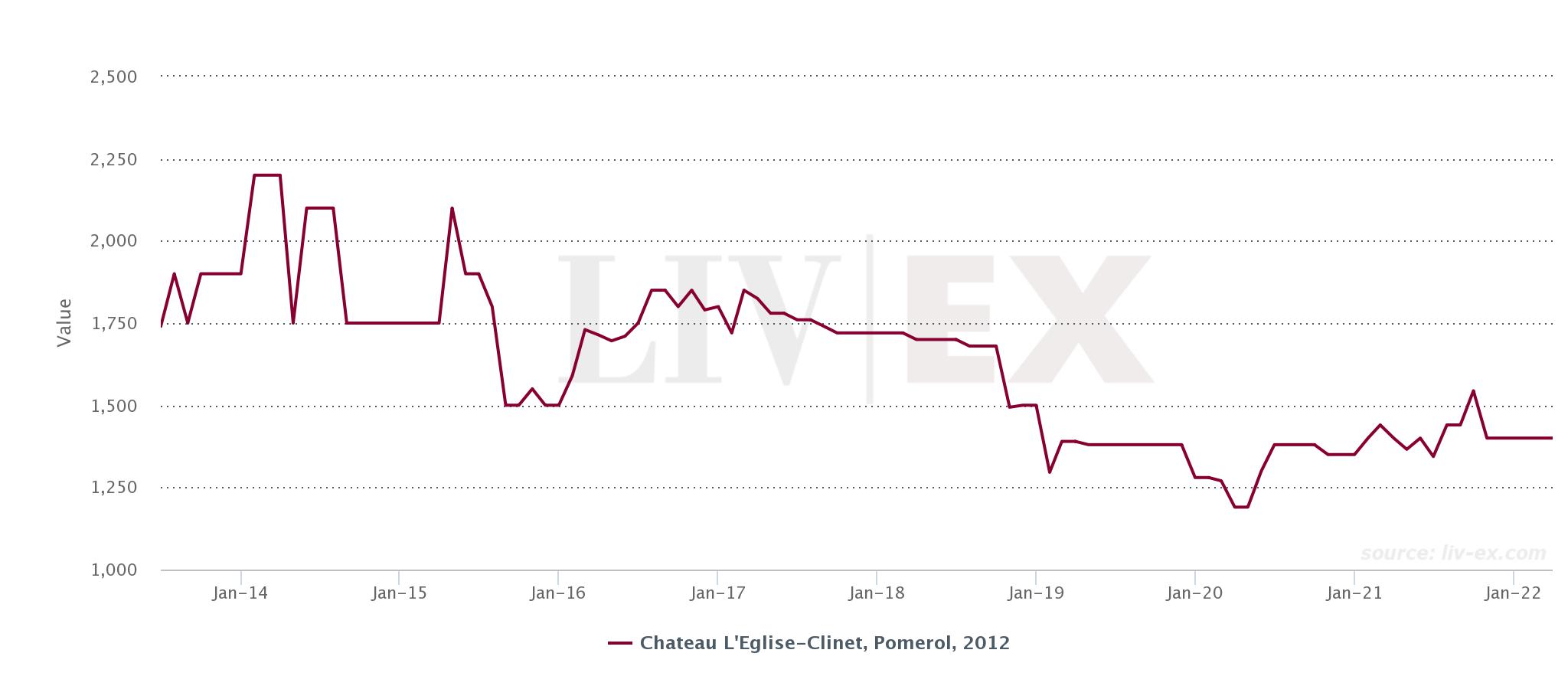
Nor was 2012 a bad vintage in Pomerol generally, scoring 94 for the year, (2010 scored 95, as a point of comparison). L’Eglise Clinet 2012 looks very good on the Amphora proprietary wine investment algorithm, and at £1,400 can be accommodated in a portfolio of any size. A larger portfolio should buy multiples; it will be worth the wait.
L’Eglise Clinet is currently in a rare run of winemaking form. Since 2015 it has scored no less than 98 points each year, even in 2017 when the overall vintage score was only 90 points, and we feel it is only a matter of time before the market wakes up to its position as a core Pomerol producer.
Pomerol is unusual in so far as it has no classification system. Everyone is aware of the 1855 classification system as it pertains to the Left Bank, and of the Grand Cru Class designations in St Emilion. We will not see such “elevations” in Pomerol as boosted the prices of Angelus and Pavie when they were promoted to Class A wines. There is good reason to think, though, when a producer is constantly matching a very top name like Le Pin in terms of Wine Advocate score, on production volumes that are still very small, that there should be significant upside in its prices.
If you’re interested in us sourcing some L’Eglise Clinet 2012 please click here and we will be in touch.