
Wine market update pre En Primeur
30.04.24 – Fine Wine Investment –
A brief market update in advance of the imminent en primeur campaign. We are glad to be able to report a few rays of hope that we’re through the worst of the recent correction. Below is the Liv-ex 100 (the benchmark) over the last 2 years. We can see that the market started to flatten out in Q1 2024, and even showed slight growth in the month of March. Cautious optimism abounds.
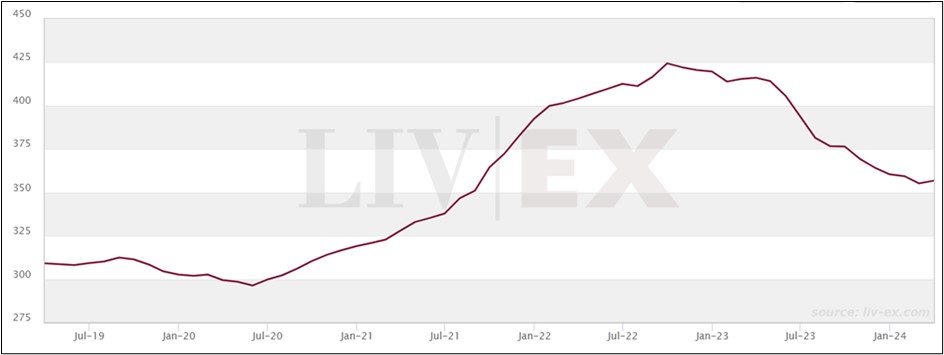
The precursor to the correction was a bull-run throughout, and as a direct consequence of, the Covid-19 pandemic. At the outset of the pandemic prices initially dropped as the world faced unprecedented uncertainty – between February and May 2020 values retreated by approximately 2% – but in June 2020 the market changed direction suddenly and dramatically to growth.
The Liv-ex 100 – which tracks a bundle of the 100 most frequently traded wines from around the world – enjoyed a stellar bull-run between June ‘20 and the peak of Oct ’22.
From late ‘23, a correction saw the Liv-ex fall by 17% before levelling out in February and returning to growth in March.
A few notes on what happened and where we are now:
Why did the market experience a bull-run during lockdown?
Growth in home wine consumption.
The frequency of home consumption more than compensated for the loss of on-premises, meaning that overall more bottles were being consumed. From March 2020 on, in the face of widespread lockdowns and the closure of most bars and restaurants, online sales of wines, increased by around 234% in 2020. During the peak of the lockdown period in 2020, online wine sales spiked more than 500%*
Non-food occasions driving wine growth where other beverages have been more dominant in the past.
Wine is typically seen as a beverage to accompany a meal, whereas beer and spirits are social drinks. During Covid this trend was upended, with a significant increase in leisure wine drinking.
Increase in average bottle spend on fine wine in the off-premises.
Wine lovers started spending more on each bottle they drank, with the increased financial outlay being more than offset by the savings in on-premises spending. Interestingly, this effect is exclusive to premium wines, with the average spend on low-cost wines having decreased during the pandemic (although that trend now appears to be reversing).
* Source: Forbes
And why the correction in 2023?
Organic profit taking.
In October 2022 the wine market hit an all-time high. We saw some gentle profit taking at the tail end of the year and into the first quarter, and then around March activity increased and things started to look rosier. Prices even nudged up a little. Unfortunately, the concurrent negative outlook for the luxury space took hold around the same time, and in the late Spring prices tumbled.
Pressure on the broader luxury goods space.
2023 was a tough year for the luxury goods space as a whole. In index terms, wine retreated by approx. 17%, which, whilst substantial, was less bruising than other luxury asset classes. For example, the Bloomberg Subdial Watch Index came back some 40%. The back story for many luxury goods was similar. The easing of COVID restrictions led to a sudden burst of activity as consumers rapidly spent their lockdown savings. But that effect was short-lived and soon cooled. Against a backdrop of high inflation, the global cost of living crisis, and lacklustre economic recovery from China, markets quickly turned bearish.
A highly competitive arena against the traditional markets.
The strength of the tradition markets was unhelpful. The S&P, for example, gaining 25% against wine’s 17% fall kept investors away.
What’s the situation in 2024?
Much improved. Wine indices flattened out early in 2024 and even returned some modest growth in March. We’re always quite interested in the LVMH share price here at Amphora. As the globe’s largest luxury goods group and, it’s a reliable barometer of sentiment in the luxury markets. The luxury goods space at large suffered heavily in 2023, but has jumped by some 24%, adding some €150bn to their market cap and pushing the pan-European STOXX600 to its highest level in 2 years. This is LVMH’s biggest gain since 2009. That said, LMVH share price has cooled a little over the last couple of months, but nonetheless remains rather healthier than in ’23. The Haggerty Ferrari index is back on the up too.
What also seems clear is that the pandemic has focussed people to reassess where and how they enjoy their luxuries, and how much they are prepared to spend on them. During the pandemic, whilst restaurants, bars and pubs were firmly off the menu (not to mention international travel) drinking a fancy bottle at home became a very justifiable “little treat”. This trend has continued beyond lockdown.
Notably, this effect is most prominent in traditional wine drinkers (expected), women and Gen X. It is reasonable to conclude that this recalibration of priorities will persevere well beyond the pandemic, in which case we are seeing a shift in consumer attitude and activity that will have an impact on demand (and therefore prices) that extends well into the future. It is rare that wine drinkers downgrade their buying decisions.
Current opportunities?
Below is the long-term graph for the Liv-ex 100, which gives you a clear snapshot of the prevailing trajectory. If ever the adage “buy the dip” were true for the wine market, it’s now.
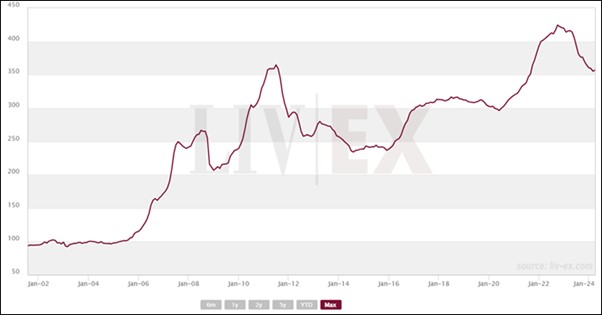
Of note are the 2020 First Growths. They were released to the market in 2021 in the en primeur (in barrel – wine futures, if you like) campaign at wildly optimistic prices following a string of botched campaigns. They’ve dropped harder than most wines due to being the furthest from their drinking window – at release the were in fact more expensive than back bottles vintages of equal or better quality, so they made no sense whatsoever. That said, they are truly sensational wines thought of in the same breath as the 09s, 10s and 16s. At current prices they would appear to be, in relative terms at least, something of a bargain.
Separately, the new en primeur campaign, where the 2023 vintage will be offered for sale in barrel and two years ahead of bottling, is about to launch with a vengeance. The wine trade en masse has been lobbying the chateaux for a return to sanity, and a significant drop from last year’s release prices. We’ll be writing more on this in coming days, but our analysis suggests that the discounts will need to be in the region of 40% for us to even consider adding them to our portfolios. C’est possible? We’ll find out in May.