
Wine investment profit and pain
08.08.22 – Fine Wine Investment –
Mercifully we can now bid farewell to the ill-fated 2021 En Primeur campaign. Having discussed its flaws in earlier notes there is no need to re-hash here. Suffice to say it is now regarded, other than for the occasional gem (boy did we have to choose our 21s selectively! Lafite being the greatest surprise), as one of the most ill-considered and uncommercial in recent times, and it has to be said it is a fairly crowded field. Of late only in 2019 can the producers be said not to have been utterly numb to the realities of the outside world.
Mind you it is possible to argue that the whole market has been numb to the realities of the outside world over the last couple of years, and this merits some discussion.
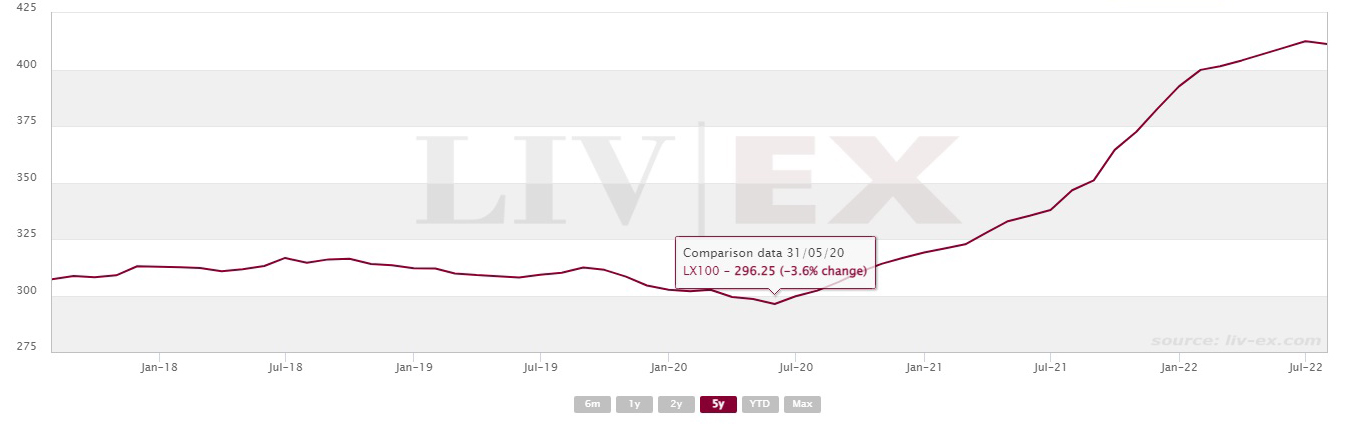
The date noted on the above chart, or one reasonably close to it, will resonate around the world as the time of the onset of the pandemic. Whatever your views about the virulence of the disease or the handling of the international response it would be quite unusual to suggest that the world felt more comfortable in this period than in those that went before. One of the major buyers of Fine Wine, namely HK/China has been more or less in total lockdown ever since.
Just when some of the major economies decide to “live with the virus”, Russia invades Ukraine, with economic consequences of which we are now all too familiar. The index on the chart, the Liv-ex 1000, sat at around 425 at that point. It is now almost 15% higher. So does the Fine Wine market exhibit the same blinkered characteristics as the Bordeaux producers?
Happily a “market” is such a huge amalgam of different hopes, fears, players, finances etc that it can never satisfactorily be countered. A market is never “wrong”, because it is the only place (99% of the time) where you can get a price for your goods. Yet it is never completely right or else it would be impossible to engineer outperformance against it. It is a multi-faceted entity. Which of the buyer or seller is “right” at the point of transaction? Both, is usually the answer, because they are equally reacting to their individual circumstances.
If a poor En Primeur campaign adequately represents the tin-eared insensitivity of the producers to their own market place, what does the Fine Wine market performance represent in the face of myriad economic and geo-political pressures?
Financial markets are sufficiently complex that you can usually buy an instrument that will perform well in any given circumstance. On a simple level, if you think the stock market is going down, you can sell a stock short (meaning you sell it without actually owning it), and if you are right you can buy it back once the price has declined and net yourself a tidy sum. This means that “whatever the weather” it is possible to own things that appreciate in value.
At Amphora we have long argued that the Fine Wine market is highly resilient to exogenous shocks, and we believe the last couple of years are further proof of this. In order to make hay in any market place it is important to understand why that might be, so it seems a good time to rehearse the unique attractions of investing in Fine Wine. This we can do in a single sentence, predicated by the fact that Fine Wine is so designated because, unusually in the wine market, it improves over time as it ages in the bottle. As it ages it is consumed, so you have the unique investment quality of diminishing supply and increasing desirability, leading to upward price pressure.
The answer to one interesting question for the market is more elusive, however. Do Fine Wine prices do better in times of economic pain, or pleasure? Logically we might think that since Fine Wine is a luxury item more of it might be bought during times of economic bounty, but this speaks to another crucial aspect of the market: it exists for both consumers, and investors, (and indeed for collectors, but let us subsume that category of participants within “investors” for the moment).

It is rational to propose that consumption might rise when economies are doing well and people are feeling flush, but what have we here? The best performing sector within the market over the first six months of this year has been Champagne, surely the outstanding totem for happy times? Are people buying all this Champagne because they have so much to celebrate? Possibly, but far more likely that they are laying it down in expectation of both happier times and rising prices ahead. The dividing line between the consumer and the investor can be gossamer-thin at times, but the scale of production of Champagne might infer that those buying now are investors rather than consumers.
Either way, this captures a further alluring aspect of the Fine Wine market. If there is good reason to buy when things are good, and buy when things are bad, the only question is exactly what should I buy. And that is exactly where we at Amphora come in.