
The Italian Petrus
There are certain precepts that hold true in most market places, of which the law of supply and demand and its effect on prices are undoubtedly one. In fact, the entire fine wine investments industry essentially hinges on this essential principle. Limited production + diminishing supply = increased prices.
At APM, we often wonder about the drivers of demand, because the supply side seems more fixed. We know there are strict limits to production, and we know that as soon as it is bottled, wine is drunk.
What we also know is that in many cases, the degree of production limit has a significant part to play.
How many cases?
Estates like Domaine de la Romanée-Conti and most of its contemporary Burgundy fine wine investments producers produce just a fraction of the wine quantities seen by the likes of the Bordeaux Chateaux, mainly because their plot sizes are so small. This almost immediate scarcity has a dramatic impact on prices in the secondary market.
The same is true of Le Pin, with its miniscule output of around 400-600 cases per year, and Screaming Eagle, who occasionally stretch to 750 cases.
The alliance of high quality, limited supply, clever marketing and the sanction of a critic like Robert Parker, forces prices up to eye-watering levels.
In Bordeaux, long the cornerstone of the fine wine investments market, most Chateaux produce rather more than this, and even someone like Petrus will make 2,500 cases most years. Most First Growths make over 10,000 cases each year. Many of the highly prized second growth producers will release about 20,000 cases a year, with notable examples like Beychevelle going as far as 40,000.
Masseto – The Italian Petrus
Across the spectrum in other parts of the world, our gaze lands upon Masseto, which has come to be referred to as the ‘Italian Petrus’. There are three reasons for this moniker: its production level is also 2,500 cases per year; it is made with the Merlot grape; and it is jolly expensive.
Even the most experienced players in the fine wine investments market will find it surprising that the 98 point Masseto from 2001 costs more than every single First Growth going back 25 years bar the Lafite and Mouton 2000 vintages. It was a decent year sure enough, but ‘only’ generated a vintage score of 94, against the 96 of 2004 of 2004 and the 97 of 2006 and 2009.
That really is an extraordinary statistic. So the 100 point 2009 Latour is worth less than the 94 point 2001 Masseto? One of the world’s most prestigious producers made a perfect wine in arguably the best vintage of all time, and it’s cheaper than Masseto 2001. How the mighty have fallen.
The chart below highlights the performance of this magnificent Masseto against the same-scoring (98 pts) Latour from the iconic Millennium vintage, 2000.
This is a 5 year outperformance of over 70 per cent.
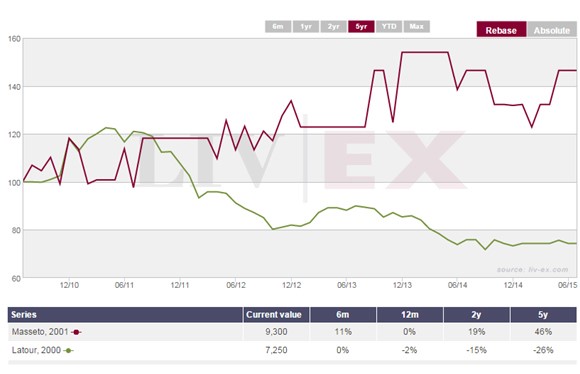
Production of fine wine investments
Of course, all of this may be explained by production levels. Latour has a large plot and churns out a good 18,000 cases, so what happens when supply really does diminish? Over time, as consumption truly impacts availability, you would expect this excessive production to have diminishing influence.
In other words, you would expect the rising desirability to increasingly offset initial production, and sure enough, we find the 100 point 1982 costing £16,500 and the 100 point 1961 costing £18,000. This is seen at an even greater extreme with the 100 point Haut Brions from 1989 and 1961 which come in at £11,250 and £23,400 respectively.
So what conclusions can we draw from this?
There is insurmountable evidence of availability (or lack thereof) significantly affecting prices, which obviously underpins our central supply/demand thesis. This is supported across the spectrum, yet curiously, the 96 point 1988 Masseto should have become almost extinct by now, but still trades at a 35 per cent discount against the aforementioned 2001.
This suggests that being the last person to own a case of a back vintage Masseto may not offer quite the same cachet as an old First Growth. If this is true, then not only is it difficult to see Masseto 2001 perform from here, but we might perhaps also conclude that a reversal of the Masseto 2001 and Latour 2000 trade cannot be far away.
We continue to increase weightings of First Growths in most portfolios.
A final point. Ausone produces even less than Masseto at 1,800 cases per year. We find, however, that Ausone seems to reflect this at its price points across most vintages, except perhaps 2003, where an immaculate 100 point scoring wine is compromised to a degree by a vintage score of only 90. The discount offered by the Ausone 2003 does, however, increase its appeal.
Stay tuned to our fine wine investment updates, for more industry updates, and specialised wine investment reports.