
The Fisher King
Back in August, we wrote some fine wine investment news about how and why fine wine is not a commodity (A Great Face for Radio 25/08/15). Over the last few months, two things have become apparent. The first being that the Bordeaux end of the fine wine investment market has been struggling to make headway, and the second, that commodity prices have come under further downside pressure. So, does this make us modify our view?
One of the world’s renowned investors, Ken Fisher, once wrote a book entitled: “The Only Three Questions That Count.” The sub-header: “Investing By Knowing What Others Don’t.”
The three questions alluded to in the title are:
What do I believe that’s wrong?
What can I fathom that others can’t?
What is my brain doing to mislead me?
At APM we extend this to try and identify pricing anomalies. If X + Y demonstrably = Z, but the market is making Z available at a big discount to X + Y, then we tend to think we are on to something. This isn’t particularly new, of course. Stock market analysts are constantly on the look-out for mispricing’s, which they tend to be able to arbitrage away.
But it is also instructive when we apply what we are seeing in the fine wine investment market to the outside world, and it is this that brings us back to commodities.
This is a chart of the copper price:

Does it remind you of anything? How about this?
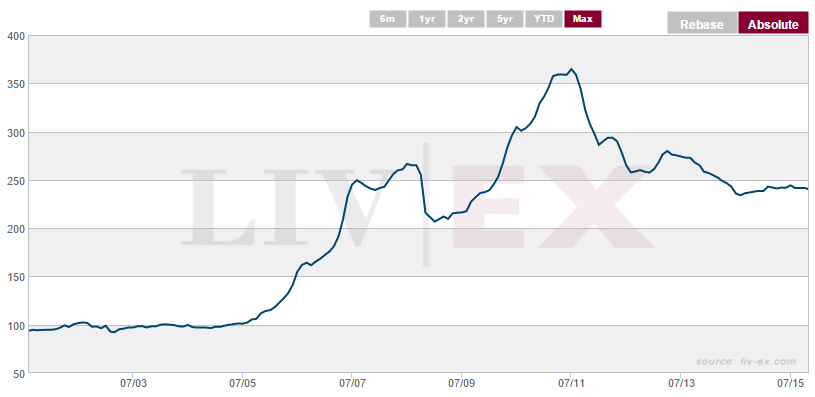
This, of course, is the Liv-ex 100 index going back over a similar period, and although the extremities are more marked, there is no disguising the general trend.
In case anyone might think copper is somehow divorced from the rest of the commodity world, here is the CPI (commodity price index):
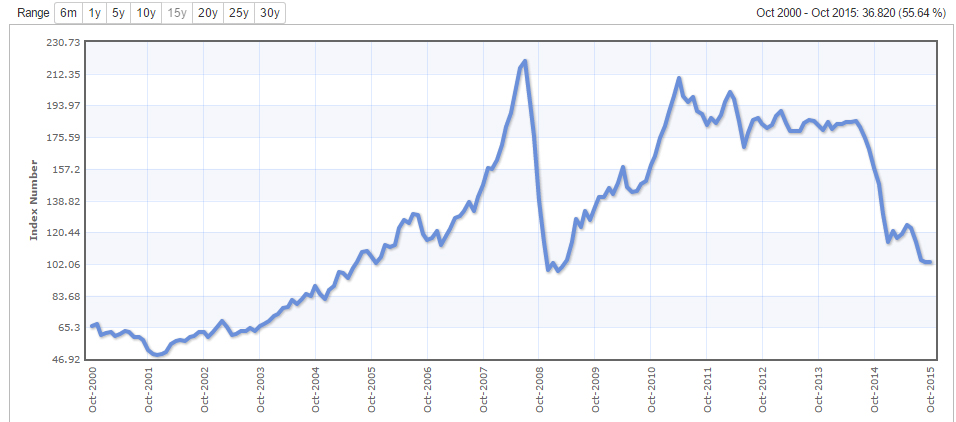
Commodity prices and fine wine investment
This differs from copper largely due to the influence of oil, whose chart is very similar.
The question now is, to what extent do commodity prices reflect what is going on in the underlying economy? It is tempting to think that there must be a relationship, and obviously there is. Economic growth gives rise to an increase in demand, which would drive prices up, all things being equal. The problem is, they aren’t.
Commodity prices simply do not reflect what is happening right now, for the simple reason that increases in production take a long time to come on stream, and this makes it incredibly difficult for producers to plan.
In addition, commodity prices tend to reflect demand from the physical side of the economy. When services play a big part in economic growth, as they are doing right now, there is less demand push.
This brings us to the heart of the matter for fine wine investors right now. Is there anything we can fathom that others can’t? I believe there is.
As the price charts above tend to illustrate, fine wine prices as expressed through the Liv-ex 100 and therefore only representative of the Left Bank in Bordeaux, are behaving suspiciously like a commodity. Yet as we have argued in the past, fine wine is not a commodity. There is too much variety available in the marketplace for it to be commoditised. And if you don’t believe that, check this out:
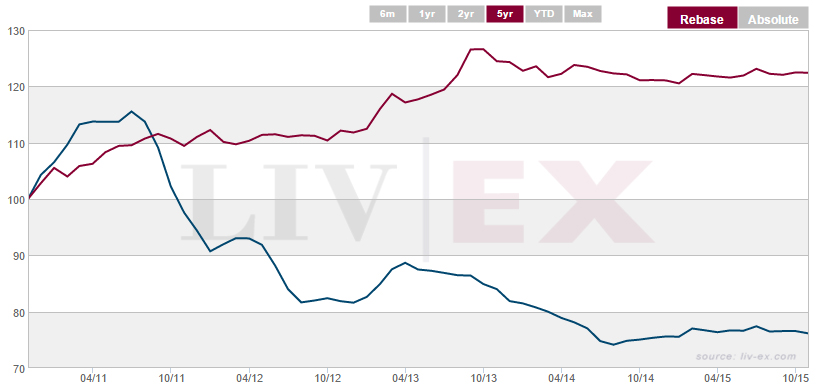
This is the outperformance of the Super-Tuscan sub-index against the Liv-ex 100.
Not only is there too much variety, but as we at APM have again been at pains to stress, there is something very different at the supply side of the equation. In the world of commodities, increases in demand lead, eventually, to increases in supply. Yet this CANNOT happen in the world of fine wine investment. Supply is FIXED.
Right now the global economic picture is benign, acknowledging for geopolitical risk. It is certainly throwing off enough millionaires to support the fine wine market, and drive it ahead, even as to the Left Bank of Bordeaux.
The First Growths have lost their lustre over the last 4 years, but it would be a brave man to bet against 200 years of impeccable cachet bringing them back into focus at some stage.
Amphora are fine wine investment experts and help investors build and curate fine wine investment portfolios through a variety of specific services. Contact us today to find out more.