Superseconds Update
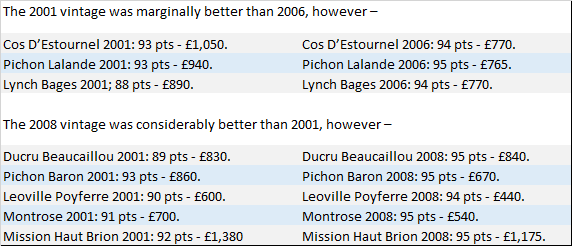
In March (“The Superseconds”) and July (“Super-Sonic-Second Opportunities”) APM highlighted a number of wines from “off-vintage” Supersecond territory that seemed to be trading at the wrong price. The logic behind this is hardly Nobel Prize material: if one producer makes a higher-scoring wine from a superior or equivalent vintage, that wine should trade at a premium to its other off-vintage sisters.
There may be an argument to suggest that older wines, being scarcer, should trade at a premium, and to a degree they should, however these producers tend to make almost twice the production of a First Growth chateau. Pontet Canet, Duhart Milon, Cos d’Estournel, the Leovilles, are into the 20,000+ cases per annum, Lynch Bages over 30,000, and Beychevelle over 40,000 cases, so you will have to go back some years before diminishing supply has a meaningful impact on prices.
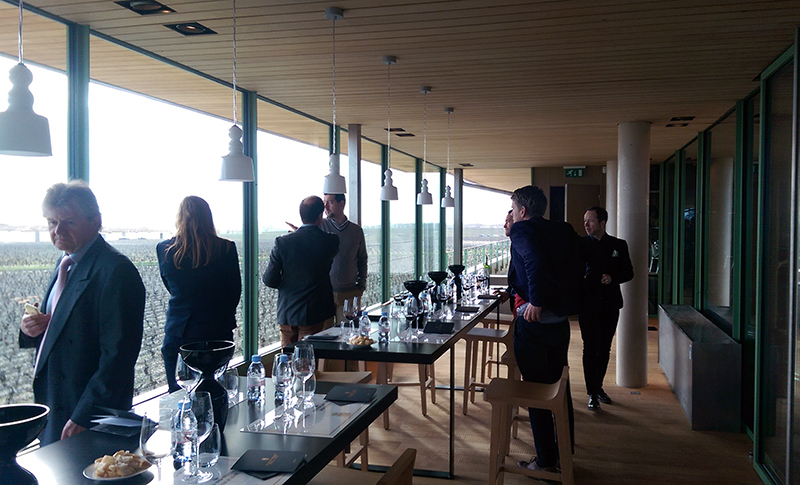
The team tasting at Supersecond Château Pichon Lalande.
The wine market is, happily, not as efficient as many other trading markets, principally because the volumes transacted are insufficient to justify the expense of creating a single clearing system, so most transactions remain “over the counter”. This means that it is quite hard to monitor, given the number of wines and vintages that are available to trade.
The key is to spot the right places to look, and to draw coherent associations across the multiplicity of prices. For example, if we can establish that x should cost x, and the relationship with y is to the ratio of, say, 1/1.2, then you can go some way towards establishing what prices SHOULD be.
Most markets have degrees of inefficiency, usually caused by differing perceptions of the same set of facts. One person’s “buy” is, by definition, another person’s “sell”. That is what makes a market. In the fine wine market there tends to be a much greater degree of fungibility than in other markets, and it is this that helps us spot anomalies.
At APM we look at around 3,000 wines across the whole market place, through the prism of our proprietary algorithm, and this helps us determine relative value. When we find anomalous pricing, the algorithm helps confirm our hunches.
The wines we recommended earlier in the year have firmed up well, and over the last 3 months a dozen more across a range of Supersecond vintages and producers have notched up 5% gains, this in a sector which has had a quiet summer.
Investing in the fine wine market is not a “have a few of these, old chap” process. You can do a lot better than simply “hoping for the best”.
The Supersecond exposure is an important sector within our portfolio-based approach. Here are a selection of further recommendations: