Shaken, not stirred
01.03.24 – Fine Wine Investment –
Those of us whose tea caddies were down to the last few leaves will have been alarmed by headlines recently suggesting that shortages were just around the corner. Shipping routes through the Red Sea are being affected by the Houthi interference so our future tea bags are having to take the long way round the Cape of Good Hope. Shelves of PG Tips in Manchester were being stripped by hoarders, screamed one inflammatory article.
To most of us all this would have been the cue for an(other) eye roll, but the episode speaks to an eternal truth: the law of supply and demand. This message is repeated at regular intervals – who will ever forget the loo roll shortages during lockdown – but it underpins the single most crucial aspect of investment policy. Some might suggest that the concept of “value” is more important, but in investment terms a) value is in the eye of the beholder, and b) diminishing value (i.e. price rises, or a return on your investment) is only consistent with the underlying supply/demand equation.
Most people like chocolate, but it takes interference in the supply of cocoa beans to make prices go up in the shops. So, indeed, it is with stocks and shares, and so it is with every single thing anyone has tried to make any money out of since time immemorial. Particularly “collectibles”.
Fine wine is a “collectible”, although it does differ from other luxury items in a (very broadly) similar investment space because it is also consumable and investible. That said there are similarities which find at their core the issue of availability. James Bond’s Aston Martin in Goldfinger costs a lot of money because there were only two ever made, and so on.
For various reasons “luxury” investments had a tough time of it in 2023, whether their market place was mainstream or not. Few businesses are more mainstream than LVMH, and its share price had declined from over 900 last April to under 650 at the start of this year, in the face of the myriad concerns that 2023 gave rise to. It has since rebounded to 800 in a signal which should not be lost on investors.
There is a tendency to be paralysed by newsflow into thinking that, at best, “things” will take a long time to unwind. The wise course then is to keep your investment powder dry, so to speak. The problem with this is that markets of all shapes and sizes are incredibly adept at discounting all the available information. Markets as a result look ahead, and when we have had a darker yesterday the balance of probability is on a brighter tomorrow.
In the case of LVMH one of the key concerns was one of which investors in Fine Wine might take note: China, with its economic slowdown and crisis in its property sector, high youth unemployment and sluggish recovery post pandemic in travel to Europe etc etc. China has long been a key part of the story for both them and us so it was very reassuring to hear that sales are recovering better than expected with the Louis Vuitton brand itself back up to 70% of 2019 sales levels.
We should also note that the S&P 500 is in all time high ground now that the market is focussing on a soft landing for the economy and lower interest rates ahead, consistent with the improvement in the inflation statistics. On the face of it the world is beset by problems of one sort or another, and the US itself is about to embark on a Presidential campaign led by two candidates many observers are scratching their heads over, yet the equity market manages to look through all this, and so, perhaps, should we.
It is really important to stress that conditions have to be right for any market to move ahead, and one of the most important of those conditions relates to what the market has been doing in the relatively recent past. If a market has been rocketing ahead it needs more and more fuel to keep it going, whereas, witness LVMH, if nothing much has been happening it often takes much less to light the blue touch paper. We note with interest the movement in the Hagerty Ferrari index, for example, which is now powering ahead after a period of stagnation and decline, and this brings us back to the Fine Wine market.
As we know, the Fine Wine market had a good Lockdown, boozing being one of the few pleasures allowed during that period, and over the last year has corrected some 15% in Liv-ex 100 terms. There has been no specifically bad news but the market had done well and as we know the global backdrop for luxury goods has been questionable.
Under historic circumstances we might have been getting excited around now in preparation for the en primeur season, but the producers have made a considerable hash of pricing in recent vintages, and something we have long argued appears to have come to pass: buyers have gone on strike. In the past, in order to secure allocations in good vintages, merchants have had to take delivery of indifferent vintages which have often been priced too high by the producers. The merchants’ deep pockets perpetuated this absurdity, but it now appears they have called a halt.
This will be a disaster for some producers and it is not beyond the bounds of possibility that some Chateaux will be sold or even go out of business. What this impasse is likely to create, in our view, is a greater focus on historic vintages. Whilst it is undeniably true, for example, that some of the recent vintages have been very good, there remains a large question mark over their availability to market. In other words, if at en primeur they did not find a good home, or even any home at all, their constant drip onto the market place will inevitably compromise price performance.
This is not the case for older vintages which in addition are now well into their drinking window, and thus supply is constantly being taken off the table in the delightful process of their being consumed. Thus we see the perfect opposite situation: we have no way of knowing the availability picture for newer vintages, whilst we know for certain that older vintages are evaporating before our very taste buds. And we have the strong sense that merchants will be buyers but not of the newer stock. They have to put something onto their shelves!
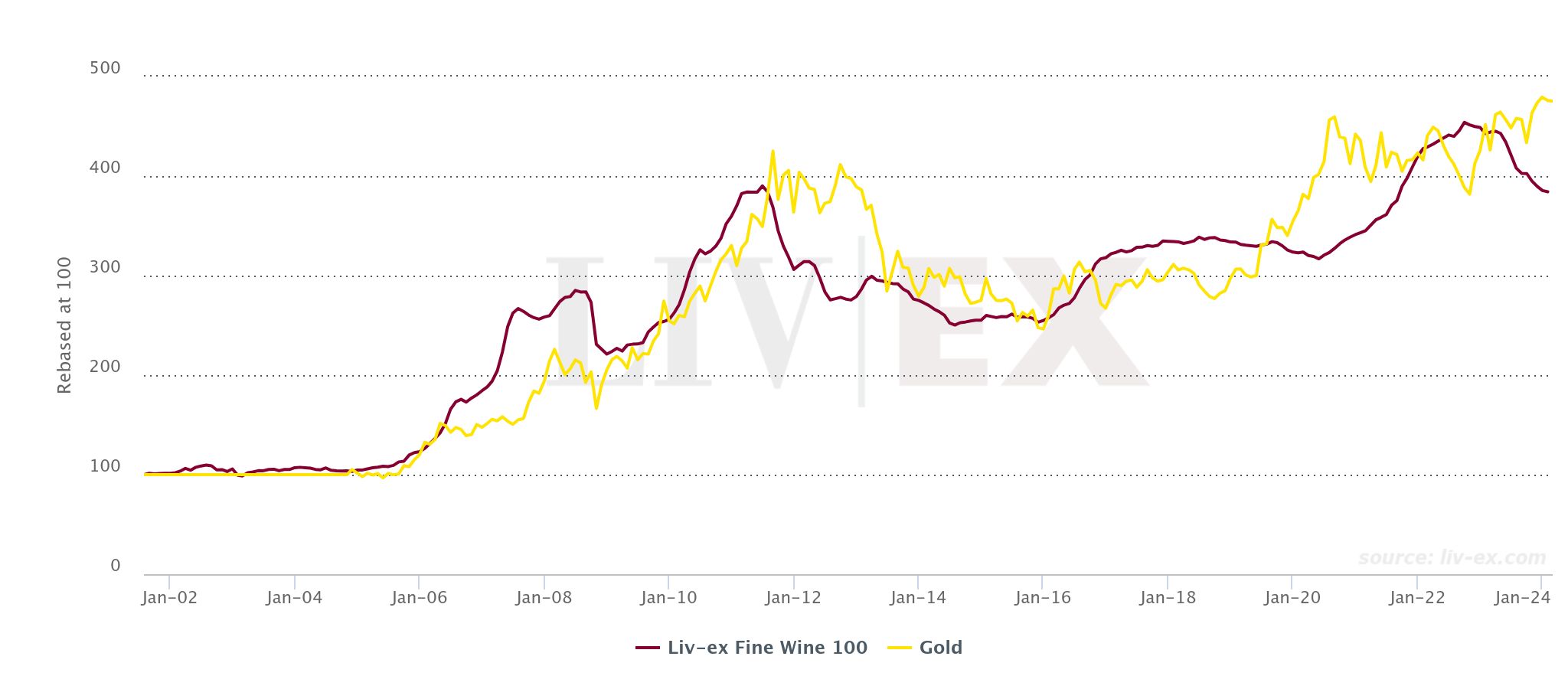
The chart below is an old favourite. This is the relative performance of the gold price in yellow against the Liv-ex 100 in red, going back to the turn of the century. At various times they have diverged, before returning to some degree of equivalence. The cacophony of concern in recent years whether it be geo-political or inflation has benefitted the precious metal price. It is possible the gold price corrects from here, of course, but for us the auguries point to a brighter future and a recovery of fine wine prices, with some of those Bordeaux back vintages in the forefront of price performance.