
Reflections
Our travels to Asia last week clearly came at an interesting time, as world stockmarkets were being soundly pummelled by concerns related to the slowdown in China, and the dramatic declines in the Shanghai and Shenzhen bourses.

China is important for many reasons: it is now the world’s largest consumer of fine wine; it was responsible for the fine wine market spikes back in 2011; a variety of commentators blame the anti-corruption campaign for the perceived lethargy in the fine wine market; and so on.
So we thought that what we picked up on the ground might be of interest.
We will leave the state of the Chinese economy to the economists. Suffice only to say that for all the noise typical of the state of arousal and heightened awareness that collapsing stockmarkets bring, major international companies who do business in China are not reporting any major disruption or slowdown to order flows.
But what of the anti-corruption measures that have theoretically stymied the fine wine market? Undeniably there is a crackdown taking place. It is said that corruption oils the wheels of industry in Asia, and this is all very well provided the slice that ends up going into some influential person’s pocket does not compromise the main event.
Here is a passage from an excellent article penned by Cathy Holcombe for the South China Morning Post of 22nd September:
“In a recent article in the East Asia Forum Quarterly, (William) Overholt (a Senior Fellow at Harvard University Asia Centre) explained why corruption in China did not hold back development or economic potential as in other Asian countries, such as India or the Philippines.
China has traditionally specialised in ‘graft’ – which is when officials take kickbacks as they execute their duties, such as the construction of highways. They enrich themselves, but they also produce good highways. If not, they lose their positions.
Corruption is when public funds are pillaged to the point where there is no money left to execute duties – quality highways do not get built, nor power plants, ports, or rails lines.”
The article goes on to say that that is precisely what happened under the administrations of Hu Jintao and Wen Jiabao, and because the infrastructural developments were compromised, current President Xi Jinping has stepped in and blown the whistle. Hence the crackdown on corruption.
So what has all this got to do with the fine wine market?
There seems little doubt that people were in the habit of oiling the throats of Government officials with First Growth inducements, but we believe it would be a mistake to overstate the significance of this. In the months leading up to June 2011 Asian speculators hoarded Bordeaux Left Bank wines in astonishing quantities, and it was as these came back onto the market in light of a combination of events (crackdown on corruption, slowdown in China, Euro crisis unfolding etc. etc.) that the market became depressed. The speculators saw the crackdown as the end of the party.
Significantly this plight has only affected Bordeaux. The following chart illustrates how other regions have done since the crisis.
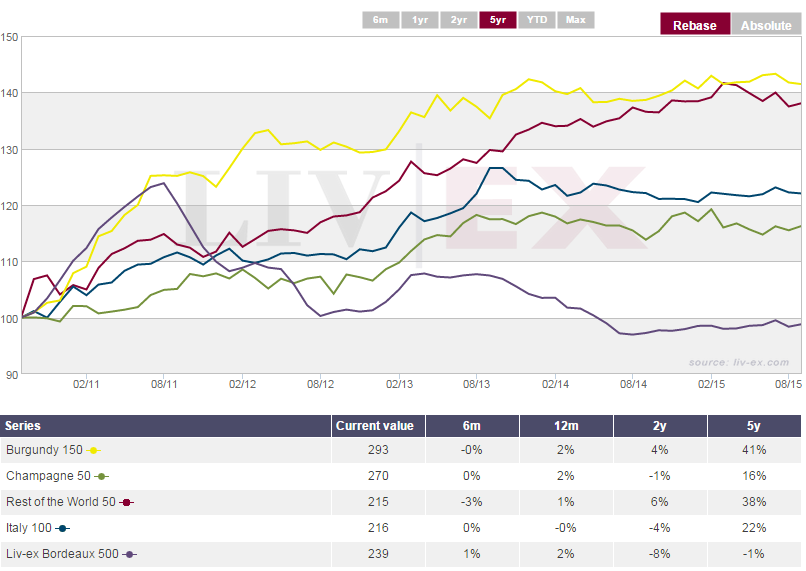
As can clearly be seen, from the Bordeaux peak in summer 2011, all other regions have outperformed. This is precisely because they didn’t fall prey to the earlier rabid speculation.
Possibly the most interesting line is the yellow one: Burgundy. Burgundian wines are incredibly expensive. Anecdotally over the last couple of years the only DRC we at APM have witnessed being drunk has been in China. The point being, that the high net worth drinkers in China are still very much alive and well. They simply turned their attentions, temporarily we believe, away from Bordeaux.
In the first part of this year, overall wine exports from HK to China were up over 40% year on year. Following more than a decade of growth, wine exports to mainland China direct from Bordeaux fell 16 percent in 2013 and 19 percent in 2014, but in the 12 months to the end of June 2015 there was a 3% rebound and more recent figures show an even bigger leap: during the second quarter of 2015, Bordeaux exports to China rose 43 percent!
This is no more than we have been anticipating. Consumption levels are on the increase, and after a quiet couple of years the merchants are having to re-stock. As in the broader economy, when growth is negligible, inventories are allowed to dwindle. When they start to be replenished it is usually a very good sign of happier days ahead.
We believe it is time to start viewing wines and their prices once again on their respective merits. Top line Chinese economic growth may slow down, but the country is still throwing off millionaires by the dozen, and many of them continue to aspire towards ownership of Western luxury goods, like fine wine. The crackdown on corruption will continue, but this is now very much “in the price”.
For these reasons, and with a further glance at the above chart, we continue to increase portfolio weightings towards Bordeaux, and advocate increasing exposure to the fine wine market overall.