
Past performance and 2017 predictions
January 2017 – Past performance and 2017 predictions.
Happy New Year!
Diversification in a fine wine investments portfolio
We have spent quite a lot of time over the last 12 months talking about the benefits of diversification in the fine wine investments process. While this is generally a good rule of thumb for any investment type, this just happens to work particularly well with fine wine. The portfolio approach allows the investor to maintain a measure of control over the level or risk exposure.
If you invest £150,000, you can either mitigate your investment risk by choosing of a diversified portfolio of, say, 25 different wines, or you can put all your money on one vintage, such as Domaine de la Romanée-Conti (DRC). Irrespective of vintage, they all cost a fortune.
Clearly from the naked perspective of trying to make an investment return, one is riskier than the other. In the latter case, if Burgundy tanks, you’ve had it. In the former, you have insulation from the rest of your portfolio.
Investments and risk
Most investors ask for a simple, balanced fine wine investments portfolio, meaning the weightings are moderated by the desire for diversification. But it’s not always as simple as the two options: the risk levels can be adjusted. If you felt convinced that Burgundy was likely to outperform, but wanted to moderate the degree of risk, you might wish to double the weighting towards Burgundy.
From the perspective of a model portfolio, the edges in terms of this risk appetite tend to be softened. Despite this, we at Amphora Portfolio Management still feel that there is further to go in terms of the outperformance of Bordeaux Left Bank wines, and we believe that the uptick seen in the 2009 and 2010 vintages is likely to be maintained. Our model portfolio therefore will see some overweighting in that direction.
Since it’s good to apply some parameters, we have restricted this portfolio to the current millennium. As wines are drunk, availability diminishes and volumes in the market place shrink. This has an impact on spreads and pricing. We suggest that older wines might more reasonably enter enthusiasts’ collections rather than fine wine investments portfolios, which might need to be liquidated at any moment.
Most Amphora clients have enjoyed a spectacular run in Château Margaux 1996 of late, for example. Despite this, we wouldn’t now be putting this into new portfolios, and would recommend selling.
Weightings
The model portfolio has the following approximate weightings:
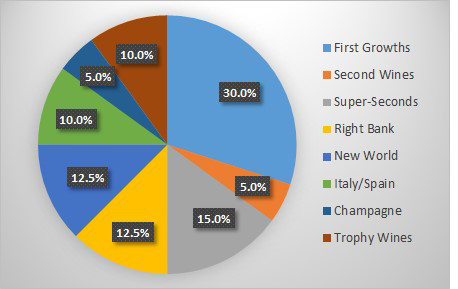
There are several key points to make here. Firstly, Bordeaux is the dominant element, representing 62.5 per cent of the total exposure (ex the ‘trophy wines’). This is because Bordeaux is the foremost producer with greater variety and overall production than anywhere else in the world.
If you had a portfolio in which Napa Valley was the dominant feature, you would likely dramatically raise the risk profile. Opus One 2002 is the leading wine from Napa in fine wine investments algorithmic terms, for example, it’s very difficult to find any, let alone sell it when the time comes.
Burgundy is noticeably absent. It is Amphora’s view that Burgundy is the purlieu of the collector and well-heeled consumer, rather than the fine wine investor. Frustrating as this may be, given the performance of certain Burgundy wines, the difficulty lies once again in marketability. Producers offer their wines to the market in such small batches that there is almost immediate scarcity. This is great if you happen to be a long-standing customer of a merchant like Corney and Barrow, the sole importer of DRC into the UK, but not much good to anyone else.
The minimum sectoral weighting is 5 per cent of total exposure. This is important for two reasons:
- You need enough for there to be an impact when the wines go up in value.
- It is easier to keep an eye on how a sector is doing if you have some of its skin in the game.
At a certain size, a portfolio can afford to include some trophy wines. By their very nature, these wines are both very expensive and can be less marketable; and you shouldn’t have more than around 16 per cent in a balanced portfolio. In this portfolio, apart from the Petrus and Le Pin we have included Screaming Eagle, arguably a cult wine, and although it is designated in the New World section, it certainly overlaps with the trophy wine sections.
Our fine wine investments portfolio
Here is the portfolio. Let’s see how it performs in 2017. May Bacchus bless her and all who partake in her inestimable delights!
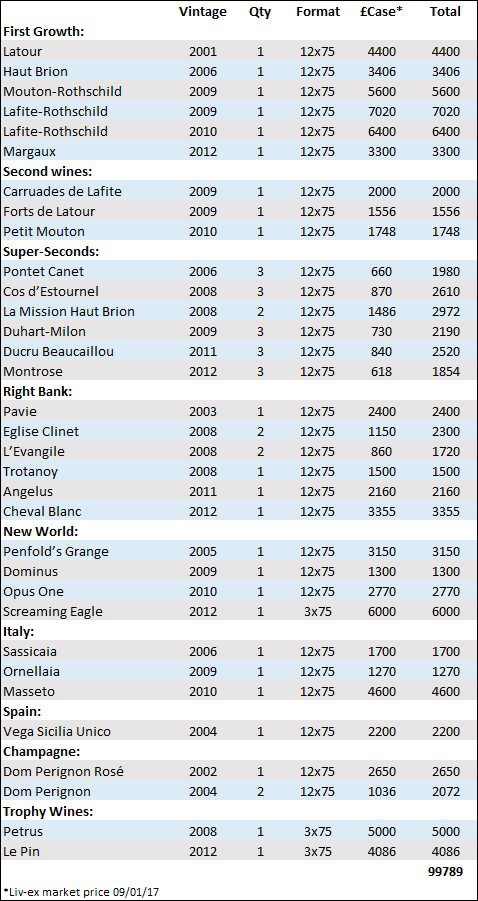
Predicting the future is one thing, but looking back on our past performance is far more straightforward. Below is the Amphora past performance of £10,000 invested in wine starting back in Q2014.
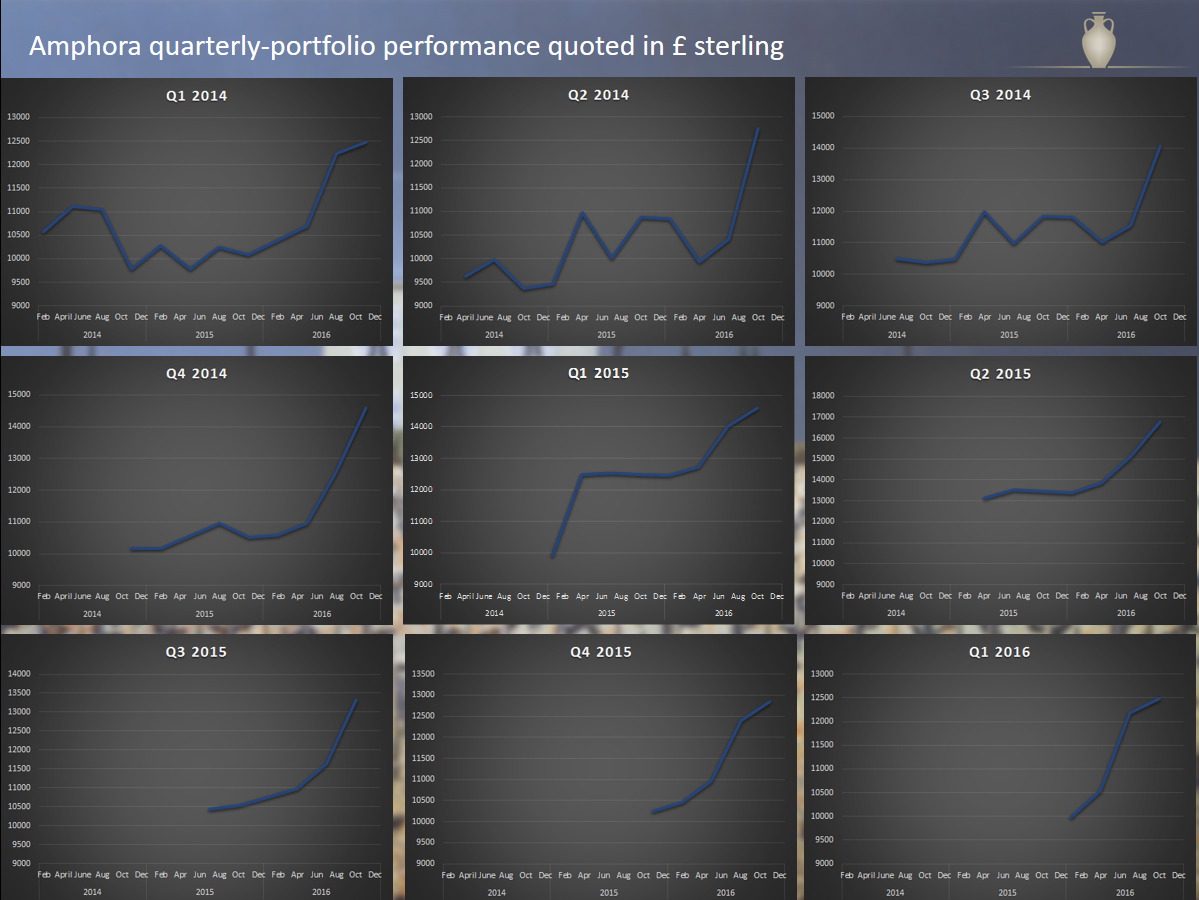
Components available upon request.
London wine investments
If you’re looking to get the most out of our fine wine investments expertise, and invest in your own portfolio, then have a look through our fine wine advisory services. Alternatively, look through our wine investment articles for more analysis and wine investment reports.