
It’s inevitable
Have you ever read sentences like: “if you had invested $10,000 in Berkshire Hathaway in 1985 it would be worth $1,000,000 now”, and wondered how on earth to grab a bit of the action? It’s actually very difficult, unfortunately. The investment industry is bound by a variety of things which prevent the majority of fund managers from taking educated bets against the benchmarks, their interest in keeping their job, being the most significant. And if you cleave to the benchmark, which is the sensible course, your $10,000 over the same time frame turns into about $60,000.
What to do?
Well, one thing you can do is find the next Berkshire Hathaway, or Apple, or Microsoft. Feeling that smart? Me neither.
Let’s remember that the investment world is all about probabilities, not guarantees, but it is vital to assemble evidence, rather than some remote concept like intuition.
So, how does this sound?
All markets, that’s ALL markets, are driven by supply and demand. There isn’t a single free market for a single good anywhere in the world that is not driven by supply and demand. Look at the oil market over the last year. Global economies are flying. Oil prices are booming from the resulting demand. New facilities are expanding. Then whack! Saudi decides to increase supply, and prices halve.
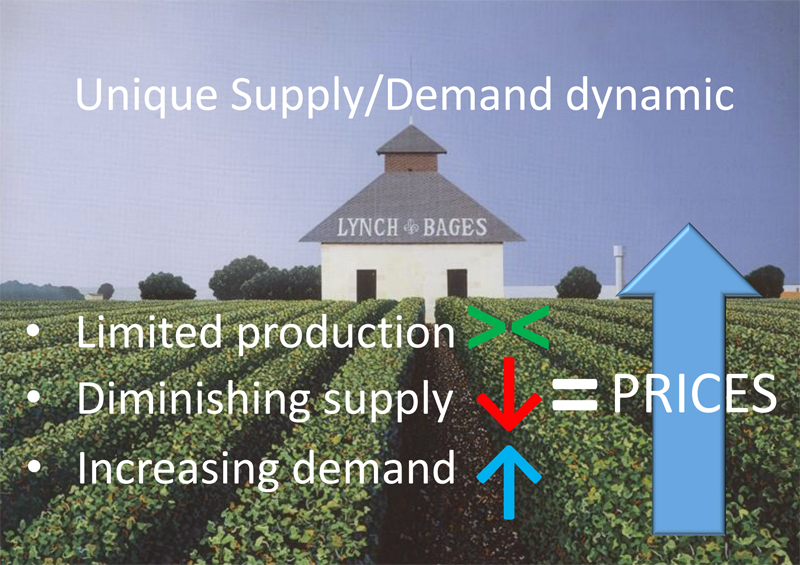
By contrast, if you have a product where supply is limited, and can’t be increased, then prices HAVE to rise if demand picks up. Your question might then be: what regulates demand?
Taking this one step further, if you have merely static demand, but falling supply, then logically you get the same result as static supply and rising demand. Prices will go up.
Well now, what have we here?
Unarguably (a very big word, but quite appropriate in this context), supply of fine wine diminishes over time. It is a most unusual luxury good. The sole purpose of the supply chain is to be destroyed.
So, if you want prices to go up over time, the supply side is doing its bit.
What of the demand side?
Following the above argument, demand merely has to stay constant for prices to rise. This is effectively what happened for about 50 years after the end of the war, leading to misleading references to uncorrelated returns. (Only misleading given what has happened since.)
APM clients will be familiar with this chart, showing the Liv-ex investibles index performance against gold, the Dow Jones, and the Footsie, going back to 1988.

This is what happens when supply diminishes, and demand rises, as opposed to staying constant. Fantastic outperformance.
It is with some interest, therefore, that we read today’s report from the Economist Intelligence Unit. China will overtake the US as early as 2026 in nominal gross domestic product in dollar terms. By 2050, India and China will EACH be richer than the next five nations (after the US), Indonesia, Germany, Japan, Brazil, and the UK, COMBINED, representing “a scale of wealth relative to the rest of the top ten that is unique in recorded history”.
It’s not like China and the fine wine market aren’t exactly on intimate terms, either. China’s emerging acquaintance with fine wine was partly responsible for the price hikes over the last decade, as we know. China is already the largest consumer of fine wine in the world. If the rate of economic growth as forecast by the Economist Intelligence Unit is anywhere near accurate, what do you think will happen to consumption levels?
And what of India? APM launched its joint venture in India last summer, so we feel reasonably well qualified to suggest that against China, India isn’t even at the starting blocks yet. India is enjoying a period of economic optimism which most commentators, the Economic Intelligence Unit included, believe is going to lead to an era of substantial economic growth.
What is interesting about this, is that in China ten years ago wine consumption was almost unheard of. Maotai and whisky ruled the roost. There was no cultural affinity for wine consumption. This is absolutely not the case in India, where wine is very regularly consumed. Consumption is rising at 40% per annum. Up to now, this is predominantly locally produced wine, but we believe this is going to change.
As with other developing countries, economic growth throws off many millionaires, and in this world of global community these millionaires aspire towards ownership of Western luxury goods. Rolex on your wrist. Bentley in the garage. Petrus on the dining table.
In India, additionally, it is far more usual than China to find people who have visited the vineyards of Bordeaux, Tuscany, and Napa Valley.
As of now, the only obstacle to rocketing sales of fine wine, is import duty. This currently sits at 160%. Even the wealthiest (whose net worth would make your eyes water), baulk at enriching the Indian exchequer for the sake of a bottle of wine. In order for India to take its place at the top table of global economies, it will have to address such protectionist policies as this.
A glance at the above chart is a reminder of what happened to imports of wine into HK and China when duty was removed back in 2008. For the global fine wine market, India is the next shoe to drop.
There has been much toing and froing on the Free Trade Agreement front over the last couple of years. This is about “when”, not “if”.
All of this comes at a time when people like Morgan Stanley and The Intelligent Partnership are producing reports highlighting a shortage of supply to the market place in coming years, in the face of this rising demand.
Well, do we have the next Apple or Microsoft at our finger tips? Whilst that would be fanciful, there seems no reason to believe that this unique combination of diminishing supply and escalating demand will not lead to significant returns from the fine wine market place over the next few years.
Put down a sum that you will neither miss, nor will hopefully require urgently in the near term, and allow the market’s magic to do its work. As the wise investment adage goes, it is time in the market, not timing the market, which leads to the best returns. And it’s all tax free!