
Fragile China, starting to crack?
Tempting as it may be for fine wine investors to get excited about last week’s trading on the Liv-ex 50, it’s probably worth reflecting that this isn’t usual for January. In fact, over the last 5 years, January has been a positive month on this index each year bar 2014, usually attributed to the proximity to Chinese New Year. The index now stands at 268.4, the same level as 27th October – after which it slid to 261 over the subsequent three weeks.
Today’s Liv-ex
We’ve written before about the application of technical analysis to the wine investment market. A chartist looking at the Liv-ex 50 would have noted several interesting things over the last couple of years. Having reached what appeared to be a long term bottom at the end of July 2014, the index has traded within quite a tight range of between 264 and 272.
Once an index breaks out of such a tight range, the move can be quite dramatic. For this reason, the sharp fall in November last year might have given a fine wine investor the conniptions.
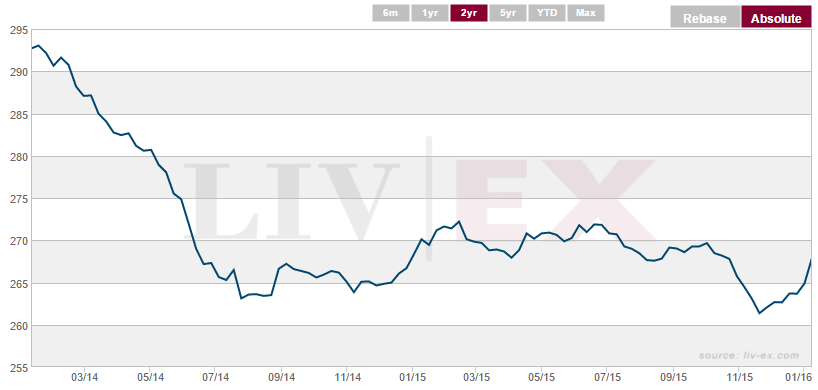
Liv-ex 50
We can breathe a sigh of relief for two reasons. Firstly, the sharp rebound from that threatening chart breakout situation, and secondly, the first notable action for Lafite in what seems like an age. 3 vintages of Lafite (2010, 2007, and 2005) were in the top 5 wines traded by value on the Liv-ex exchange last week, the others being DRC St Vivant (2011) and Latour 2005.
There are several reasons this might be important. Lafite 2010 was egregiously priced at En Primeur time, and has suffered calamitous declines in price ever since, with only one burst of activity between November 2012 to February 2013, after which interest tapered once again.
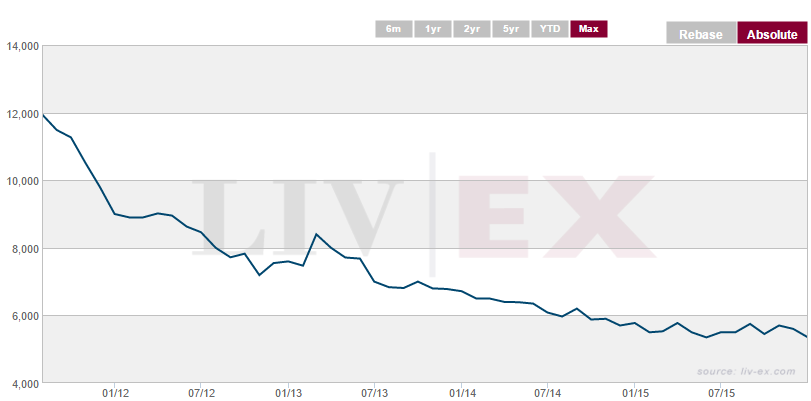
Lafite 2010
Yet 2010 is universally acclaimed as an amazing vintage, so you could argue that it has unjustifiably suffered the mid-pricing at issue time. This is much like a mid-priced stock market IPO or even a new property initially listed at the wrong price. It can take the market a long time before taking it seriously again. And how much China-related woe do we need to acknowledge when considering fine wine investments?
Growth in China
Current wisdom suggests that China’s growth is stagnating, and that they are mismanaging both this and their exposure to the capital and currency markets. Everyone loves to have a pop. So let’s add a little perspective.
China has enjoyed extraordinary double digit growth over the last 20 years. This is unsustainable. The economy is already the second largest in the world, indeed the largest by some measures. The very idea of any other major economy growing 10% is laughable. So why is this slowdown to below 10% so worthy of concern? Whether China grows at 7% or 5% this year, it is without a doubt still adding substantially to global growth because the base from which it grows is now so huge.
The first phase of the China growth project revolved around investment. Of course it did, when the infrastructure 20 years ago was so wanting. Now that infrastructure is in place, the focus on the next phase is consumption. It is hardly China’s fault that every raw material-producing nation in the world built its future on endless demand from China. All of the problems that beset Russia, Brazil and South Africa, to name but three, cannot be laid at China’s door.
For years, China had a closed capital account. If you are as big as China, you can’t wave a magic wand and open up your account just like that. It is a gradual process, one that’s incredibly hard to manage. I would not argue that the administration has covered itself in glory over the last few months, but observers should temper their expectations.
China’s task is sizeable enough anyway. And given that it was a totalitarian state until relatively recently, that task is compounded by a society awakening to the attractions of the outside world. The threat of social insurrection has been at the heart of China’s policy-making for over 30 years and won’t change at the behest of an aggrieved outside world.
The future for China and fine wine investments
Nor should anyone believe that there are too many one-way bets out there. Over the last 24 hours, we have seen George Magnus, Chief Economic Adviser to UBS worrying about how the current situation could develop into a credit crisis, with scary quotes like “I fear the worst now”. On the other hand, we have also seen Serge Ermotti saying that his investment bank is going to double headcount in China over the next 5 years, so attractive is the opportunity. And of which investment bank is he CEO? You guessed it: UBS.
So none of this is remotely easy to grapple with. From the perspective of China and fine wine investments, however, we can still take comfort from the taste the wealthier Chinese have developed for fine wine over the last 10 years. First Growth fine wine investments prices, unlike global share prices, have hardly been climbing a wall of worry in recent times. Irrespective of the shenanigans in global stock markets of late, the uninspiring performance from the Left Bank of Bordeaux may just be coming to an end.
For more information, background and updates from the world of fine wine investments, check out our wine investment blog. Alternatively, find out more about our wine investment services here or browse through the entire stock list.