
Christmas cheer
Wine investment news and US interest rates.
On Wednesday Janet Yellen put on her red Santa Claus outfit and from under her white beard produced the long-awaited 25 basis points, or 0.25% to you and me. So why is this a present?
There has been an awful lot of guff written over the last 12 months or so about the implications on global growth and world stockmarkets of the first Fed hike in interest rates since 2007, but then, of course, financial journalists need to do their bit to sell newspapers. If you believed everything you’ve read this year then the world has had countless reasons to spontaneously combust: ISIL, Grexit, Ebola pandemic, collapsing oil price, China slowdown, Chinese stockmarket crash, the list goes on and on.
But here we are at year end and we are all still alive and kicking! So what does this mean for the wine investment market? Let us unequivocally state that in our humble opinion a hike in US interest rates can ONLY BE GOOD FOR FINE WINE PRICES.
There are several reasons for this, but two are of more significance that the rest.
Firstly, whilst the Fed might have erred occasionally in the past in respect of monetary policy, at this point in time, when there has been so much global scrutiny, it will have had to be so sure of its ground before taking the step. This is as good a statement as you could see that global economic growth is not only on an upward trajectory, but is not going to be derailed by a slowdown in China, austerity in Europe, a recession in Japan, the lunacy of Donald Trump, whatever.
Of course it is POSSIBLE that the combined intelligence housed within the Fed has got it wrong, and that half way through next year the hike will be reversed, but the odds on that happening are very long indeed. And if the Fed is right, global economic growth will continue to fill consumers’ pockets with disposable income, and throw off countless more developing country millionaires and billionaires. All good for the consumption of fine wine.
Secondly, for those who think of fine wine as a commodity (it kind of is, but with infinitely greater flexibility as to how you can invest in it than in the case of other commodities), the rise in inflation consequent on rising global economic growth will apply upward pressure to commodity prices. This will seem to fly in the face of commodity price movements currently, but commodity prices usually lag developments in economic growth, because of the lead time producers require to either increase or decrease supply.
The oil market is somewhat different, obviously, because it is in thrall to the geo-political determination of Saudi Arabia, but as we have argued in the past, a low oil price, whilst something of a problem for producing countries, is a fantastic thing for everyone else. I don’t know about you but I now regard a visit to the petrol station as a pleasure, no longer requiring a prior check of the bank balance.
So where do we go from here?
At APM over the course of the last couple of years we have been at pains to stress the importance of diversification, and all the clients who followed our advice to switch out of overweight positions on the Left Bank of Bordeaux into wines from the New World, for example, have enjoyed significant outperformance:
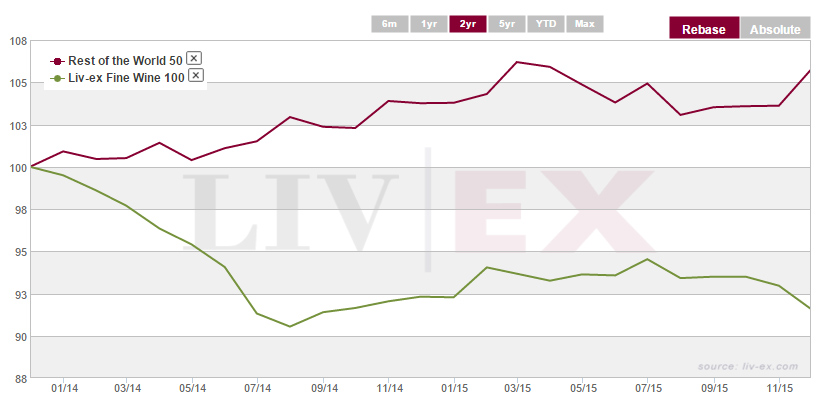
Graph: www.Liv-ex.com
The market in Bordeaux has been challenging again in 2015, although we did see a more than a flicker of interest when Robert Parker conducted his 2005 retrospective. All the wines he upgraded achieved substantial increases in price, and interestingly those he downgraded were largely unchanged. This suggests that there is money on the sidelines looking out for reasons to buy, whilst the selling pressure after the 2011 correction has now abated.
As we move into 2016 we do so again in expectation of a recovery on the Left Bank, whilst still guarding against another quiet year by operating a diversified portfolio. By March commentators will be obsessing once more about the En Primeur pricing, but perhaps without the hope vested in previous years that the Bordelais will price their wines “to go”.
2015 has shown all the signs of being a splendid year. If not quite the match of 2009 and 2010, then perhaps as good as 2005. Rather than hoping the overall market will be stimulated by a favourably cheap offering, we may find that it gets the boost it needs from the market’s acknowledgement of another outstanding vintage.
It remains only for us to say that everyone at APM would like to wish all our clients a Merry Christmas and an enjoyable and profitable New Year.