
Chindia
Nov 2015 – Wine Investment –
Since 2011 fine wine investors have become pretty clear about the impact on high-end Chinese consumption of the ongoing anti-corruption campaign, and over the last three years or so the likes of Pernod Ricard, Remy Cointreau, and LVMH have attributed declining sales to both that and President Xi Jinping’s determination to curtail lavish displays of wealth.
Over the same period APM has expanded its footprint into India, and so it was with considerable interest that we noted the statements from Diageo last week. India is now Diageo’s second-largest market by sales, and they comment that awareness of premium brands and affordability is going up. Along with competitors like Pernod Ricard they see rapid urbanisation, a young population, and a fast-growing middle class as key drivers of future earnings growth.
An article on Bloomberg goes on to state: “India, where alcohol was frowned on until recently for religious and cultural reasons, is now a battleground for global drinks makers, as groups like Diageo and rival Pernod Ricard tap emerging markets to offset sluggish growth in the developed world.”
Now, when people mention “emerging markets”, they typically mean the larger grouping consisting of Brazil, Russia, India, and China (the BRIC acronym). Currently, with commodity prices depressed (on which the Brazilian and Russian economies are based), and the combination of political disharmony in Brazil and sanctions imposed on Russia, it’s a bit of a stretch to imagine those two driving consumption of luxury goods.
India, by contrast, looks exciting, but what of China, at this moment? At some stage the depression on demand wrought by the crackdown on bribery is likely to be wearing through the wash. It has certainly been discounted, as we well know, in the prices of high marque Left Bank Bordeaux favourites.
Share prices are well known to discount all available information, and are usually good arbiters of what might happen next. If we look at the share price performance of Pernod Ricard:
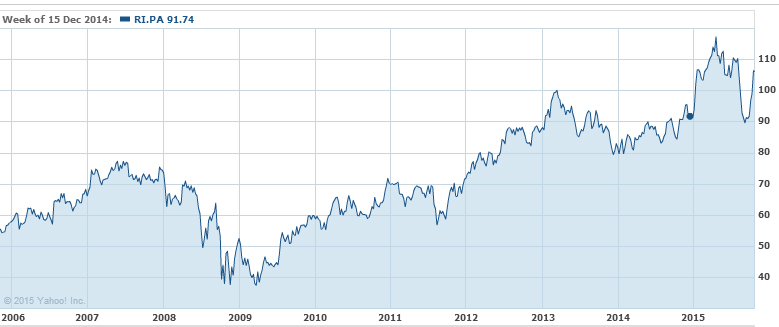
and Diageo:
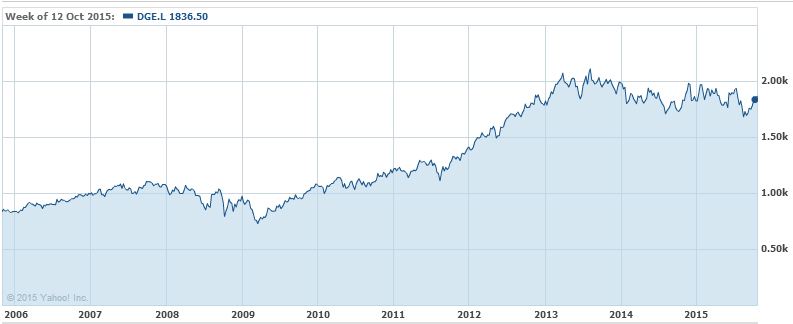
it is quite hard to sustain the argument that these are two companies struggling in the current environment. Both suffered a delayed reaction to the Chinese “austerity drive” but have recovered their composure. Both continue to report marginal declines in sales in China, but feel they are through the worst. The share price performance is certainly suggesting as much.
Recently China announced a lifting of the infamous one-child policy after 30 years which if nothing else has altered the current demographic irrevocably. The reason they have done this is to increase the size of the future work force, on which an ever-growing Chinese economy will depend. This is part of the next 5 year plan, a plan which will see the focus of the Chinese economy continue to switch from investment to consumption.
To guarantee consumption, you have to create wealth, which will continue to be a clear priority. As you create wealth, the newly rich will aspire to ownership of western luxury goods. It has been a trying few years in the fine wine market, but you don’t want to be under-exposed when the might of both the Chinese and Indian economies re-visit the delights of this market place.