
A great face for radio
Any Amphora Portfolio Management clients tuned in to Share Radio at tea-time on Tuesday last fortnight would have been delighted to recognise the dulcet tones of our own James Fletcher, as he was being interviewed on the subject of fine wine investment by Juliette Foster.
She asked all the normal questions, of course, but then lobbed one in about mainline commodities. What, she wanted to know, were the key differences between fine wine and the commodities which are part of the production chain for other manufactures? She seemed worried that fine wine was an end in itself, and had no further use other than being drunk, whereas most commodities have several uses.
Perhaps it is time to go on record: fine wine is NOT a commodity.
In the financial markets there are basically two types of commodities: soft, and hard. Soft commodities are things which are grown, like sugar, tea, and wheat, and hard commodities are things which are mined, like gold, silver, iron ore, and so on. If there was a trading market for grapes, in this way, they would be a soft commodity, but as it happens, there isn’t. The reasons are partly down to the size of the grape market, and the use to which the grape is put.
The definition of a commodity revolves around fungibility; in other words, how exchangeable are two separate ounces of, for example, gold, and the answer is, perfectly exchangeable. They are, to all intents and purposes, exactly the same thing.
Now there is scope for confusion here, because there are indeed different TYPES of coffee bean, and tea leaf, which are not interchangeable. Darjeeling is not Earl Grey, whilst Arabica is not Robusta, however in these cases the degrees of difference are not that earth-shattering (unless you are a coffee trader). And obviously there is Brent and West Texas, but the point holds.
All, that is, ALL, commodities respond to the inexorable laws of supply and demand. What is quite interesting is how long it takes producers to reduce or increase output depending on market conditions. Then, as we have seen in the oil market, there is a political angle.
In the cases of gold and silver a raft of other excuses are wheeled out to justify a buy or sell recommendation. Gold is an inflation hedge, theoretically, a “store of value” (whatever that means), a component of jewellery manufacture. Silver, they say, has “innumerable” industrial uses.
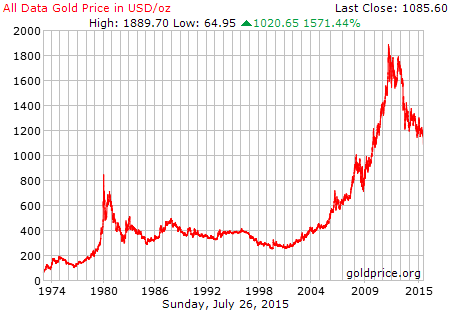
Here is the long term gold chart:
And here is the silver:
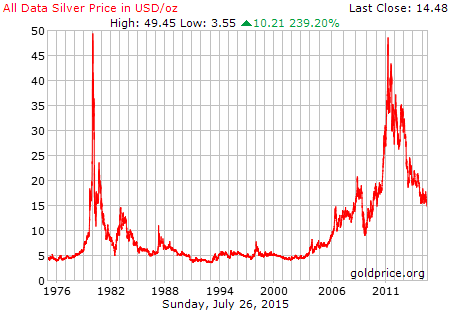
Not desperately encouraging from an investment perspective, these pictures of booms and busts and although some would argue the eventual performance makes it worth the wait, you’d have to be schizophrenic to catch the wave, rising from your hibernation every 25 years or so to react with dextrous alacrity.
Yet these are fully attested investment fields! Quite extraordinary!
The average private investor might allocate a % of an investment portfolio to gold or silver (although I wouldn’t), but is unlikely to get involved in the other commodity markets which are considered “best left to the professionals”. The key point to make is that (just like fine wine), none of these things have any “intrinsic value”, in an investment market sense; that sense in which it pays you to own them. They all have utility, unarguably, but that is not the same as value. It only pays you to own them if they go up in value, and they only do that if someone is prepared to pay more for them than you did.
What makes someone do that?
The answer IN EVERY CASE reflects considerations of supply and demand. If traders perceive an increase of one over the other, they will jump in. Anyone who thought that Saudi was going to leave the spigots open last year would have known that oil prices would collapse. That’s an easy one. What of softs? Well a lot of the time prices depend on the quality of a harvest (supply side), whilst the demand side varies according to economic conditions, or forward perceptions thereof.
So why do people think commodities are an “inflation hedge”? Because ALL THINGS BEING EQUAL, prices will go up in tandem with global economic growth (which tends to drive prices up). The problem is, all things are seldom equal, because supply side shocks (from droughts to miners’ reluctance to slow output) never match demand side forecasts, which are hard to get right.
In the fine wine market, at least something is fixed. Supply, restricted at the best of times, ALWAYS diminishes over time. That is a very helpful investment consideration. But as we said at the top, fine wine is not a commodity. There are some 60 producers making different wines every single year. The only fungibility is between wines from the same producer in the same year. One case of Lafite 2008 is the same as another.
This is extremely important, and is at the heart of the difference between fine wine and the commodities. Diversification, the cornerstone of most investment strategy, is possible in the fine wine market. With a commodity, however, there are only two decisions: should I buy it? If so, how much? That is quite a binary position to have to take from an investment perspective. Most people, quite rightly, want more options than that.
At Amphora Portfolio Management we strive to clarify the opportunities which exist in the world of fine wine investment through diversification. It is a fabulous benefit. We think people should make more use of it.