
Muskrat Love
12.01.21 – Fine Wine Investment –
If you were told at the start of 2020 what was about to happen over the next 12 months, and asked to forecast the impact on asset prices, hands up everyone who thought Elon Musk would by now be the wealthiest person on the planet. We suspect there would have been more hands in the air favouring the performance of the gold price, but maybe one or two would have reached the conclusion that the constituents of the Nasdaq index might fare reasonably well in an increasingly online world, if not necessarily extending that prediction to Mr Musk himself.
Forecasters would probably have hoped that Fine Wine prices might hold up, but may have worried in consequence of the wealth effect: in such a negative economic scenario how could a luxury item hold its value? As ever we face the same dichotomy in respect of fine wine and gold: are they stores of value, being physical assets, and thus safe havens in a time of crisis, or are they reflections of increased spending power particularly in the “developing” economies, (if China can still be considered to be developing)?
Either way as we now know hold up they did, after a predictable early decline due to the onset of the pandemic. Interestingly, as you can see from this chart, the early profiles of the Liv-ex 50 and the Liv-ex 100 differ:
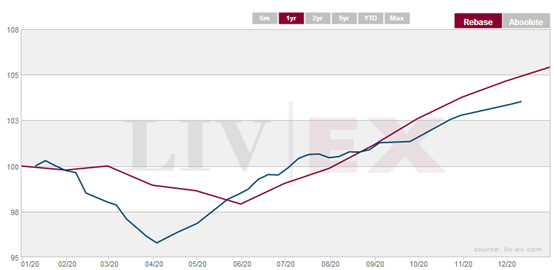
The blue line is the narrower Liv-ex 50, which represents the 10 most recent physically available vintages of the 5 First Growths (excluding en primeur prices, in other words). The red line is the Liv-ex 100, which from Bordeaux includes wines of different “Growth status”, others from the Right Bank, a few sundry older vintages as well as wines from elsewhere in the world. Clearly, although they have both ended up in the same neck of the woods, it was the more prominent First Growth sector that took the initial hit.
We don’t think there is any point agonising over whether one dragged down the other, or one rescued the other, because it is perfectly normal for the narrower index to be the more volatile. What we do think is worthy of note, though, is that in the UK overall wine sales in 2020 were higher than 2019, with the increase in off premises activity more than compensating for the decrease in on premises spending. Furthermore, wine drinkers spent more on each bottle they drank, (off sales being much cheaper), but this effect is exclusive to premium wines. For most of the year the average spend on low cost wines actually decreased.
The pandemic appears to have encouraged wine drinkers to assess where and how they enjoy their luxuries, and how much they are prepared to spend on them. With restaurants, bars, and pubs off the menu, not to mention international travel, they have enjoyed a more premium drinking experience than may otherwise have been the case. Evidently this trend is most prominent in traditional wine drinkers (as you might expect), amongst women, and Generation X, and the question is, having sampled the higher grade wines are these consumers going to take these elevated preferences into the future?
This matters hugely, of course, because underpinning the unique Fine Wine investment dynamic is the fact that availability decreases as the wines are drunk, and this brings us back to the gold price, because the supply of gold is more or less inexhaustible (in theory it’s not, obviously, but in practice to all intents and purposes, it is). Here are the long term prices of gold and Fine Wine, as represented by the Liv-ex 100:

We need to look carefully at the divergences to see what we can attribute them to, because overall they broadly speaking seem to track. 2005 was the start of the Chinese love affair with Fine Wine. In 2008 Hong Kong removed import duty making prices seem cheap, and as the Chinese wealth effect took root the Asian preoccupation with face, along with the perception of Fine Wine as a luxury good and therefore symptomatic of elevated social status, drove prices higher.
In 2011 we saw the other side of the coin, exacerbated by prices having been driven too high by speculators, when the Chinese authorities clamped down on lavish displays of wealth and local corruption (Fine wine having been readily used to buy influence and favour), whilst the gold price remained high as a result of the after-effects of the financial crisis and concerns relating to the Euro.
It will surprise no-one to learn that we at Amphora think the current gap will be closed by wine price appreciation rather than gold price depreciation. It is our view that the somewhat bizarre combination of on-going geopolitical concern (to which we might add the occasional pandemic) and increasing wealth in cultures like China and India where the acquisition of gold to be passed down the generations seems to be entrenched, is likely to keep the gold price from significant decline.
To this we would add that the one major economy which has emerged stronger rather than weaker over the last 12 months is China, and as its expanding economy throws off more and more millionaires we believe there is plenty of upside to Fine Wine prices. That said, we happily acknowledge that the prices of gold and Fine Wine may further diverge, it’s just that to us the balance of probability is otherwise. And that is the opportunity.
One final thing we should highlight subsequent to last year’s trading is that the breadth of the market continues to increase. 10 years ago Bordeaux represented over 90% of all Fine Wine trading activity. That figure is now in the 40s. Far from being a bad thing, including for Bordeaux wine prices, we believe that the expansion of any market place only increases its attractions. We are a long way from being mainstream, clearly, but more activity means more liquidity which reduces risk, and there is still plenty of inefficiency across the spectrum of Fine Wine prices to make a handsome return.