
Rising sun, falling Yen
Rising sun, falling Yen.
We have just returned from a week in Tokyo and Taipei, as APM continues to boldly take the fine wine investment proposition further into foreign parts.
Tokyo represented the first foray for some time into a developed economy beyond Europe, given that we have been focusing our recent international energies on India and China.
In all candour, it has been our strategy to be an early mover into the developing economies space, believing as we do that these places are throwing off new fine wine consumers and investors as their ranks of millionaires and billionaires grow apace. And this strategy has been bearing fruit, although we acknowledge that for the present the market, particularly as regards Bordeaux, can hardly be said to have supported our efforts.
Japan proved, at first blush at least, to receive the investment proposition much more readily than India. For the time being, India is a market of collectors, not investors. Whilst they prefer to reserve their investment energies for the domestic front, they are happy to buy investment grade wines for personal consumption rather as we would something from Tesco.

We have talked at length in the past about Indian import duties, the removal or reduction of which will see domestic consumption skyrocket, but we recognize that whilst this will make Indians drink more, it will not necessarily lead to a fine wine investment boom there.
Japan offers a different prospect. The Japanese economy has been struggling to expand for so long now that the time when the value of the Imperial Palace exceeded that of the whole of California has faded into distant memory (1988 to be precise). Interest rates are so low you virtually have to pay the bank to keep your money. At a polar extreme from India, ways to make a few bob in Japan are NOT legion, and this is precisely why we were given such an hospitable reception.
Another feature of the Japanese landscape is the aging population. Now is not the time to go into the whys and wherefores of this phenomenon, but since it exists it is worth examining the implications. As we see it, this is an aging middle class. These people have plenty of money, and at present this money is making a paltry return in both the stock market and in the bank. They are on the lookout for alternative ways of putting their savings to work.
The graph below is the exchange rate between the Yen and Sterling going back 10 years:
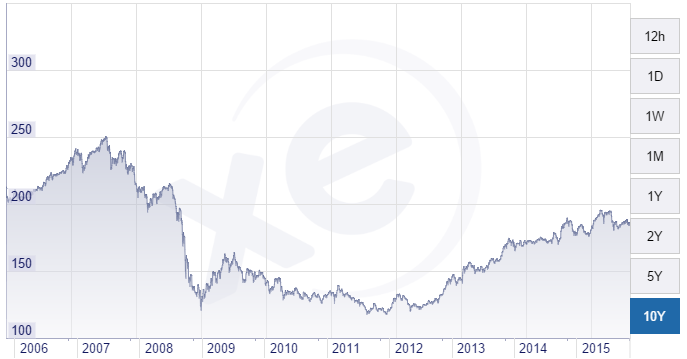
As you can see, it has been a pretty grim 5 years for the yen, but you only have to go back to 2007 to find a time when it was much weaker still. This is also weighing on the minds of the people we saw. They are well aware of the fact that Japanese interest rates are not about to rise any time soon, and they are very conscious that the next move could look something like this:
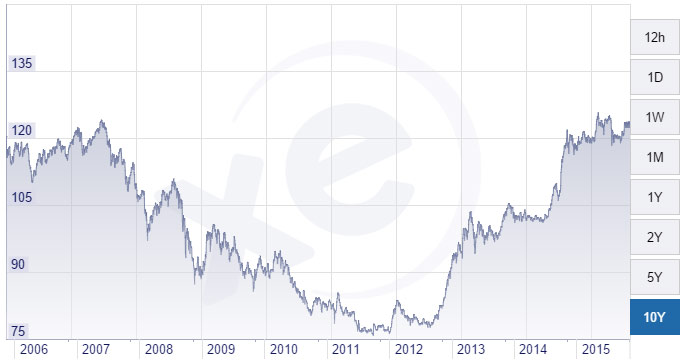
This is the yen against the US Dollar, and as you can see, when it became clear last year that the next move in US interest rates was going to be up, we saw a downward lurch in the value of the yen, back to the levels of 2007.
And what is the likely next move in UK interest rates?
Precisely.
When the Japanese investors found out that fine wine investment was denominated in Sterling, their interest, already aroused, was raised another notch.
So, ladies and gentlemen, we have an interesting new investment medium being presented to an audience starved of investment choice, in a currency which Japanese investors seem to regard as a one-way bet.
This is not just good for APM, obviously. The market especially for First Growths has become very thinly traded, and interestingly spreads have been narrowing to single figures of late, as bids have been rising to meet offers. This means that it might only take a little bit of new demand to take out a lot of the currently available stock, in consequence of which offer prices will be hiked. As this occurs, investors and consumers who may have been biding their time during the current torpor will enter the fray, which will further stimulate the market.
Whether this happens this month or over the next 6 months, this is how the next rally will unfold. Bull markets are built on confidence and liquidity, and there is no shortage of potential liquidity.
One final point I would like to share. We were discussing the merits of investment diversification in general, and the fine wine market’s ability to offer a portfolio approach in particular. One of our new investors, clearly a poker player, said to us: “Yes, I like that. Diversification is key. Having four of a kind is a brilliant thing…. Unless someone else has a straight flush.”
What a wonderful way of analogizing the point.