
Anyone for seconds?
Amphora clients have been asking us about the “second wines” produced by the First Growth châteaux. We are talking here about Carruades de Lafite, Forts de Latour, Pavillon Rouge (from Margaux), Petit Mouton, and Clarence Haut Brion.
Many chateaux produce more than one wine. Historically, any wine which after aging in the barrel was not quite up to the standard of a “Grand Vin” was sold off separately. At First Growth level these wines can still be very good, sharing many of the characteristics of the Grand Vin, but without achieving quite the same finesse and aging capability. They may last for 25 years, instead of over 50, for example.
Over the last 10 years there has been a significant change of emphasis from the First Growths. Partly this is due to the reception their second wines were given by Chinese consumers, who in the earlier stages of their love affair with red wine were just as happy with a bottle that said Carruades de Lafite as one that said simply “Lafite”.
As a result, when Lafite Rothschild was going through the roof up to mid 2011, the Carruades was doing even better. Here is the chart showing absolute price movement:
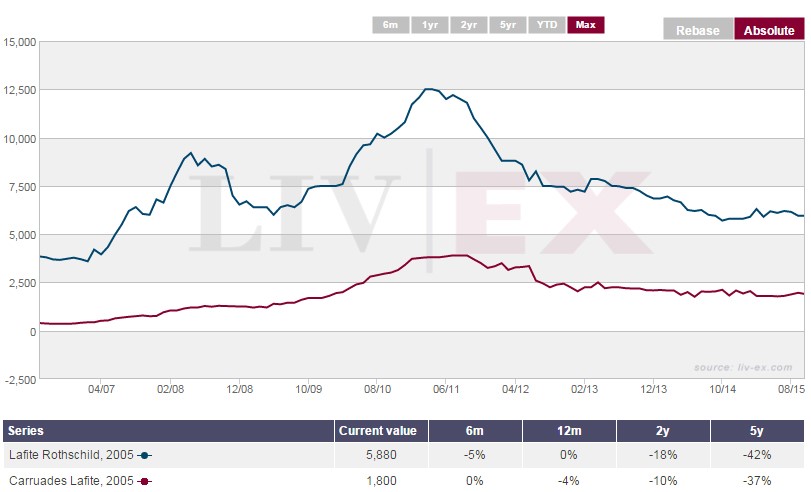
This might seem to suggest that the money was to be made in the Grand Vin, but when you look at the relative performance:
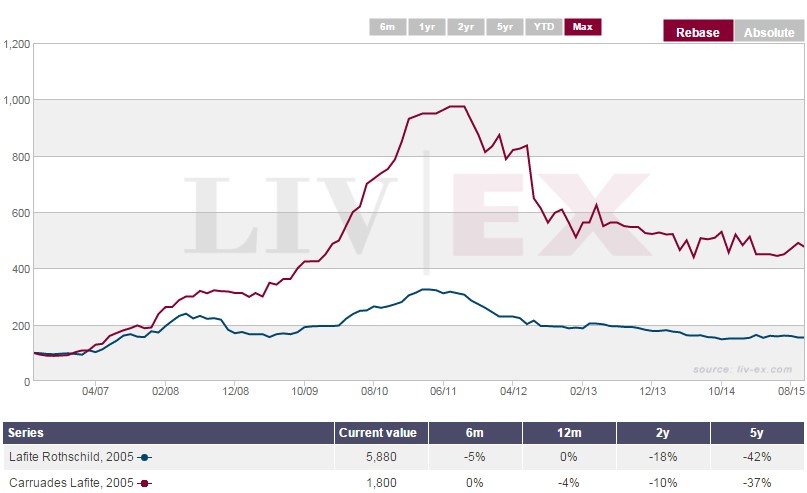
You can see that whilst Lafite performed very well, the Carruades performed extravagantly well.
The impact of this groundswell of interest by China was not lost on the producers, for obvious reasons, and it is fair to say that since around 2006/2007 they have concentrated somewhat harder on making the second wine as representative of the label as possible.
This comes through very clearly in the Robert Parker scores. Whilst is was normal for a second wine to score something in the 80s, even in a brilliant vintage like 2000, we now regularly see scores well into the 90s. Between 2008 and 2010 inclusive, Carruades de Lafite and Forts de Latour score 91, 93, and 94, and 91, 94 and 97 respectively.
In a way this makes the analysis easier: we don’t have so many back vintages to take into consideration. What we KNOW, is that in Pauillac, Margaux, and Graves, 2009 and 2010 we amazingly good vintages, some would argue the best of all time (what’s a bit of hyperbole between friends). This comes through in the scores of all the second wines, which, almost without exception, are superior to all the back vintages.
So, how do prices look?
Carruades de Lafite 2006 and 2007 both score 90 and cost £1,850 and £1,750 respectively.
The 2010 scores 94 and costs £1,400. Buy the 2010.
Forts de Latour 2007 scores 90 and costs £1,180.
The 2010 scores 97 and costs £1,390. Buy the 2010.
Petit Mouton 2006 scores 90 and costs £1,350.
The 2010 scores 91 and costs £1,175. Buy the 2010.
Pavillon Rouge 2008 scores 88 and costs £1,100.
The 2010 scores 94 and costs £990. Buy the 2010.
Clarence Haut Brion 2005 scores 89 and costs £850.
The 2010 scores 93 and costs £650. Buy the 2010.
In short, buy all the 2010s!